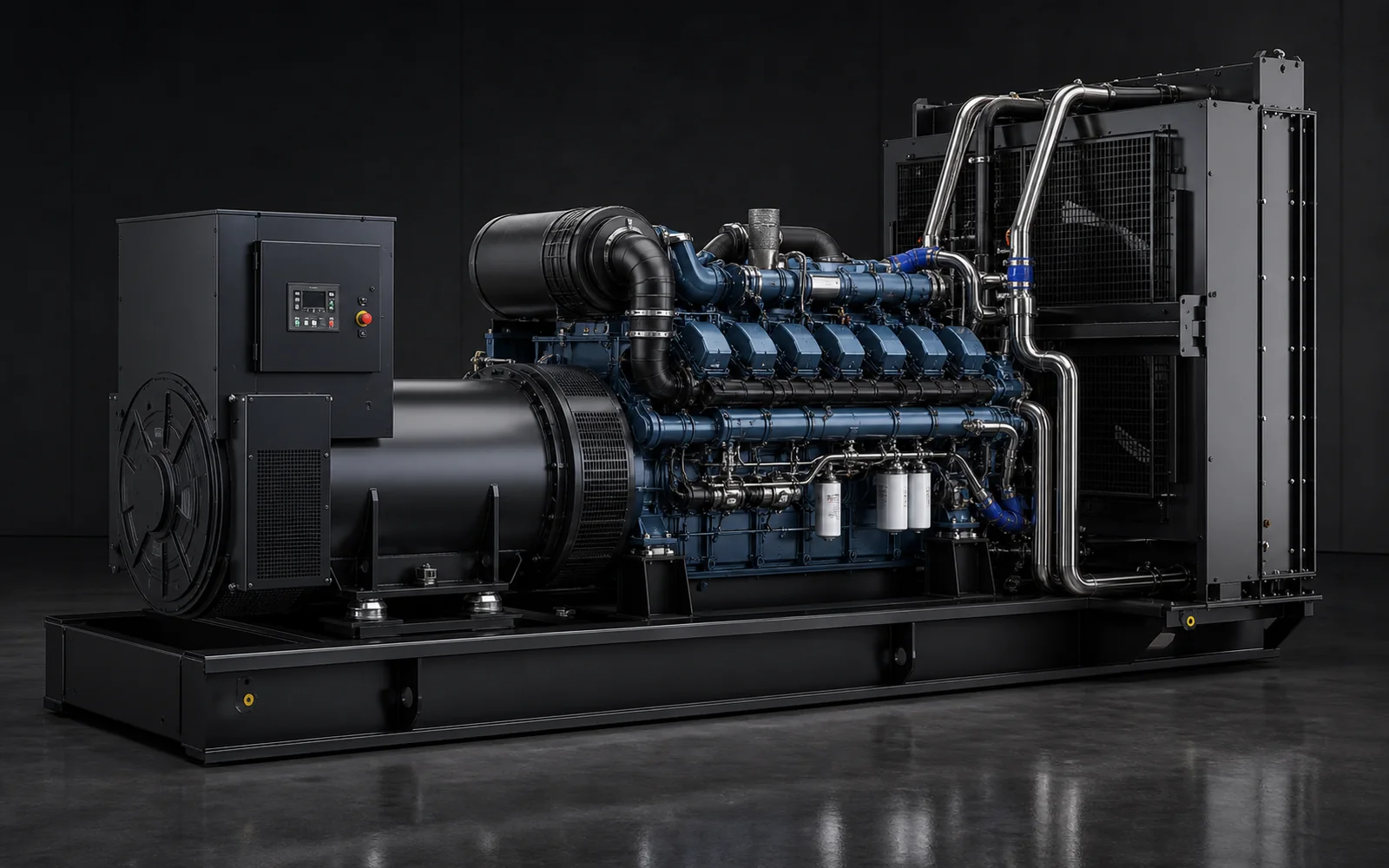
Most buyers shortlisting a diesel generator set fixate on kVA and price. The engine platform underneath decides whether the unit starts on a cold morning in Kazakhstan, holds its rating through a 40°C afternoon in the Gulf, and still has parts available when something wears out in year six. For LINKPOWER sets built on Chinese engines, three names come up constantly: Weichai, Yuchai, SDEC. They are not interchangeable.
What the three platforms actually are
Weichai (潍柴) and Yuchai (玉柴) are two of the largest independent engine makers in China, with deep footprints in trucks, marine and industrial power. SDEC (上柴, Shanghai Diesel) is the longtime Shanghai-based maker with strong roots in stationary and bus applications. All three supply the 20–3,750 kVA band that covers most commercial, industrial and project loads. See the configured sets: Weichai at https://linkpowergenset.com/en/products/weichai-diesel-generator/ , Yuchai at https://linkpowergenset.com/en/products/yuchai-diesel-generator/ , SDEC at https://linkpowergenset.com/en/products/sdec-diesel-generator/ .
Start with duty, not brand
A set running 2,000 hours a year as prime power lives a harder life than one that fires up twice a year for grid outages. Weichai's heavier-duty blocks tend to be specified where prime and continuous duty dominate — remote sites, mines, base-load support. Yuchai has a broad mid-range sweet spot for standby and prime in commercial buildings and factories. SDEC is common in stationary standby and municipal or infrastructure duty. Match the duty cycle first; the brand follows.
Parts, service and where you actually are
The cheapest engine on paper becomes expensive if a fuel injector takes six weeks to reach you. Weichai and Yuchai both run wide global distributor networks, which matters for mining and infrastructure projects across Africa, the Middle East and Central Asia. SDEC's strength concentrates around Asia-Pacific and municipal fleets. Before choosing, ask the supplier for the nearest authorized service point and a confirmed spare-parts lead time for your destination — and put both in the contract.
Emissions and the paperwork that proves it
Don't take a sticker's word for it. Whether a set needs EU Stage V, US EPA Tier 4 or China NR-IV depends entirely on where it runs and how many hours. Request the applicable emission certificate and the test report from the supplier, and have the exact emission stage written into the quotation and the acceptance document. A set that meets the wrong stage is a set you cannot commission.
Noise, packaging and site reality
Engine choice interacts with the enclosure. A Yuchai or SDEC in a well-designed silent canopy can clear a 75 dB(A) at 7 m site limit; an open Weichai belongs in a ventilated engine room you design around it. For outdoor or noise-sensitive sites, look at the silent diesel generator sets ( https://linkpowergenset.com/en/products/silent-diesel-generator/ ) and trailer or mobile units ( https://linkpowergenset.com/en/products/mobile-trailer-generator/ ) for temporary power. For high-power project work, the containerized systems ( https://linkpowergenset.com/en/products/containerized-power-system/ ) wrap the engine, tank and switchgear into one weatherproof block.
The 50/60 Hz and voltage trap
An engine rated for 1,500 rpm at 50 Hz is not the same unit at 1,800 rpm and 60 Hz. Confirm the frequency and the full voltage, phase and earthing requirement for the destination grid before locking the brand. We cover this in our 50 Hz vs 60 Hz selection guide ( https://linkpowergenset.com/en/news/50hz-vs-60hz-generator/ ). A mismatch here wastes the whole order.
Our practical shortlist
Prime or continuous duty, harsh sites, long run hours: lean Weichai. Balanced commercial and factory standby and prime: Yuchai covers the broadest middle. Stationary standby, Asia-Pacific, municipal or infrastructure: SDEC is a proven choice. None is 'best' in the abstract. The right one is the engine whose duty rating, service map and emission paperwork fit your project.
FAQ
Can I swap engines between brands on the same set? Not as a drop-in. Mounting, wiring harness, controls and cooling are platform-specific. Specify the engine at order time; retrofitting later is a rebuild, not a swap.
Which is most fuel-efficient? Close enough across the three at comparable load that fuel should not drive the decision. Load factor, altitude and maintenance state move the number more than the badge.
Do these engines meet EPA or CE? See the emissions section: it depends on destination and duty. Ask for the certificate and test report, and have the stage written into the contract. Do not accept a verbal 'yes.'
Send us the load list, duty hours, frequency, voltage, site conditions and destination. We will match the engine platform, enclosure and controls, prepare the technical selection and a project quotation, and confirm the nearest service point and spare-parts lead time before you commit.