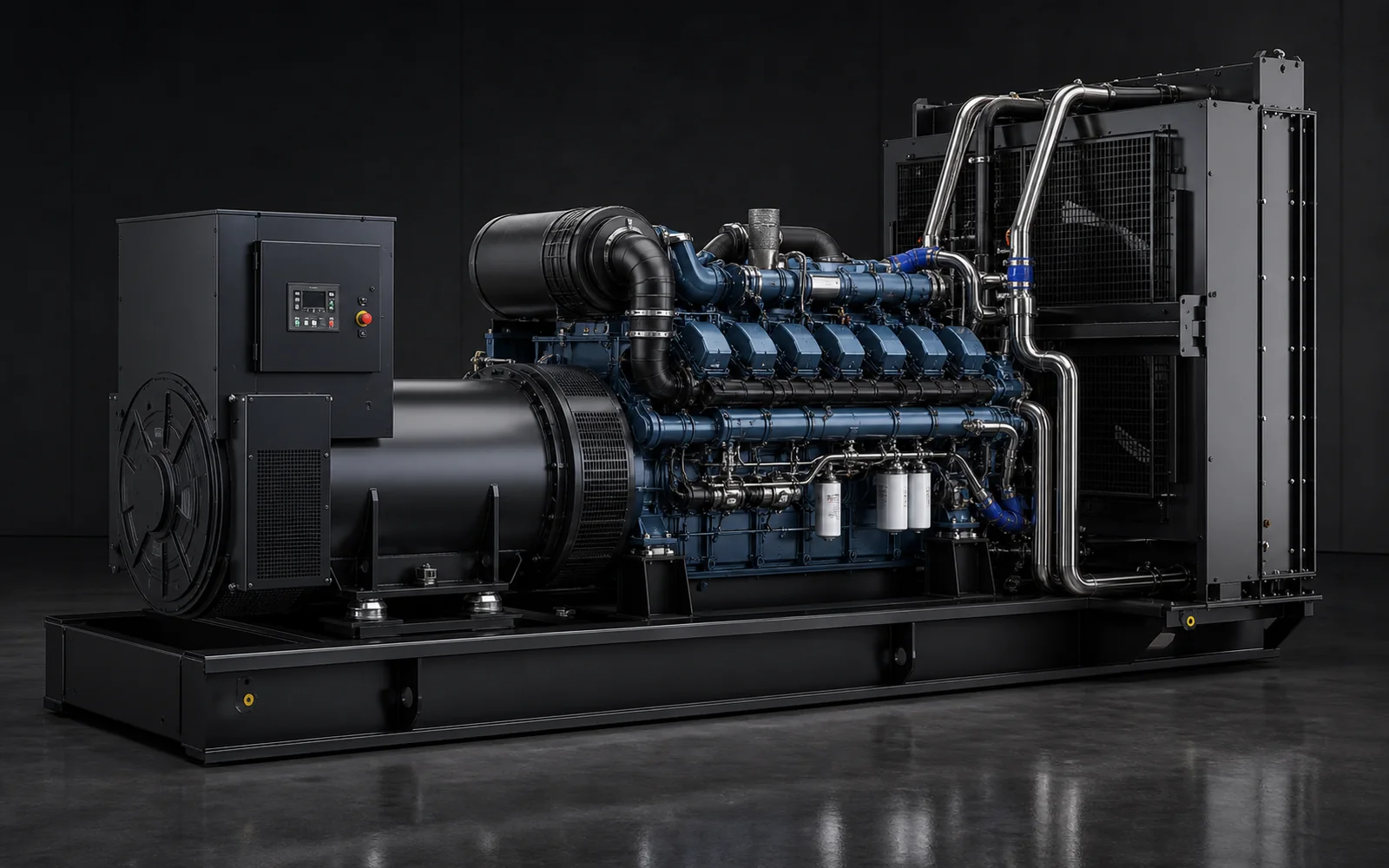
Picking single-phase or three-phase is not a spec-sheet formality - it decides which of your loads the generator can actually run, how much cable you pull, and whether your motors start on the day the grid fails. Most buyers only find out after delivery, when a three-phase compressor will not start on a single-phase set. This guide explains what each supply really powers, how to confirm what your site needs before you pay, and the signs a supplier is guessing instead of engineering.
What does single-phase and three-phase actually mean for my loads?
Single-phase delivers one alternating-voltage waveform - in practice two conductors, a live and a neutral. It is the standard for lighting, sockets, small appliances and light commercial loads, and it is what almost every home and small workshop runs on. Three-phase delivers three waveforms offset by 120 degrees across three live conductors, which lets you move substantially more power with less conductor and start larger inductive loads cleanly. If your site has any sizable motor - a compressor, a pump, a lift, a chiller, or three-phase HVAC - it almost certainly needs three-phase. The rule of thumb is simple: single-phase for small, scattered loads; three-phase where motors and balanced power matter. The exact voltages depend on your national standard, so confirm the local distribution voltage rather than assuming a number from a brochure.
Does a three-phase generator mean I get three-phase everywhere?
Not exactly, and the boundary is where buyers get burned. A three-phase set can feed single-phase loads by taking one phase to neutral, so your lights and sockets run fine off a three-phase machine - you simply leave capacity unused on the other phases. The reverse does not work: a single-phase generator cannot produce true three-phase, so if you later add a three-phase motor you are buying a converter or a second machine. There is also the question of balance - pulling heavily on one phase of a three-phase set overloads that phase while the others sit idle, so a good supplier sizes the phases to your real load map, not just the total kVA. Treat 'three-phase generator' as 'can do both,' and 'single-phase generator' as 'only this, permanently.'
How do I verify whether my site needs single-phase or three-phase before I buy?
Verify it from the building, not from the sales chat. A practical checklist: (1) Read the main distribution board - how many incoming phases are switched, and what is the marked supply voltage? (2) List the actual connected loads, especially motors, and note each one's phase, voltage and starting method (DOL, star-delta, soft starter or VFD) - a single three-phase motor rules out a single-phase set. (3) Ask the local utility or your electrician for the supply standard and earthing system; this is the number your generator must match. (4) Confirm the voltage and phase of any equipment you will run during an outage, including the ATS if you have one - a mismatch at the transfer switch is a classic install failure. (5) Put the confirmed phase, voltage, frequency and neutral/earthing requirement into the RFQ and the contract, so the quotation is checked against your real system rather than a generic export model. LINKPOWER sizes the alternator and controls to the confirmed load list and duty, so the first input we need is that distribution detail, not a target kVA.
When should I walk away from a supplier's phase recommendation?
Pause or walk away if the supplier: quotes a phase without asking for your load list or distribution board; recommends a single-phase set for a site that has even one three-phase motor, then 'solves' it with a vague converter; cannot state the alternator's phase configuration or how the neutral and earthing are arranged; gives a voltage that does not match your national standard and shrugs it off; or sizes only on total kVA and ignores phase balance, which hides an overloaded single phase. A supplier that exports and installs regularly answers these in one message with a drawing. One that cannot is asking you to discover the mistake during your first power cut.
How LINKPOWER configures phase and voltage
LINKPOWER builds open-type, silent, mobile-trailer and containerized diesel sets with Weichai, Yuchai and SDEC engines, and the alternator and control configuration are set to your confirmed electrical standard rather than a catalog default. Single-phase sets cover smaller backup and prime duty; three-phase sets cover motor loads, balanced commercial distribution and larger kVA; and where a site needs both, a three-phase machine with phase-balanced loading also runs the single-phase loads. The factory acceptance test runs against the step load and starting sequence you specify - including motor starting - before the set is crated, so phase and voltage are proven against your duty, not just printed on a nameplate. Review the factory test process, the small-set range for single-phase-class duty and the mid-range three-phase options here: https://linkpowergenset.com/en/factory/ , https://linkpowergenset.com/en/products/20-100-kva-diesel-generators/ and https://linkpowergenset.com/en/products/100-500-kva-diesel-generators/ .
FAQ
Can a three-phase generator power my single-phase lights and sockets? Yes - take one phase to neutral and the single-phase loads run, as long as the phases stay reasonably balanced. You lose no capability by choosing three-phase; you only leave headroom unused on the other phases.
Do I need three-phase for a small home or office backup? Usually not. Lighting, refrigeration, computers and small sockets are single-phase, so a single-phase set covers most homes and small offices. Add a three-phase motor - a well pump, a lift, a workshop compressor - and the answer changes, so list those loads before you decide.
What if my country uses a different voltage standard? Voltage and phase are set by your national distribution standard, not by the generator brand. State the required voltage, phase, frequency and earthing in the RFQ; the alternator and controls are configured to match before quotation, and the figures are confirmed on the test report rather than assumed.
What we need from you
Send the load list with each load's phase and starting method, the supply voltage and earthing standard, the duty (standby, prime or continuous), frequency, and whether an ATS is involved. We confirm the alternator and control configuration, run the acceptance test against your step load and motor starting, and return a quotation built to your electrical system - not a catalog default. See the full product range and the factory test process to start the configuration: https://linkpowergenset.com/en/products/ and https://linkpowergenset.com/en/factory/ .