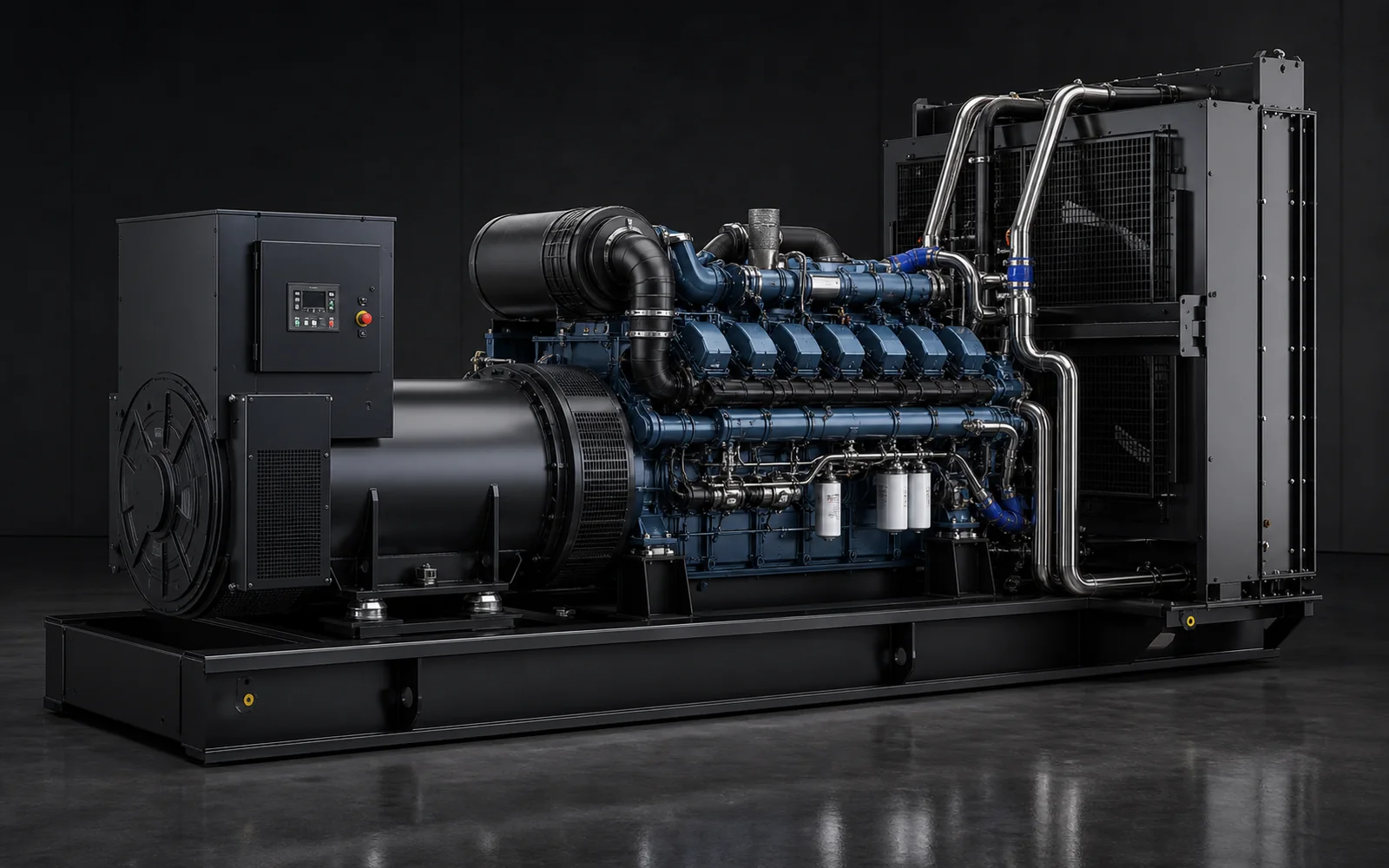
A generator specification sheet looks simple until you have three of them from three suppliers and none of them line up. One quotes 500 kVA, another 400 kW, a third promises 'low noise' with no number attached. Reading the sheet like a buyer means pulling the few numbers that actually decide whether the set will run your load, pass inspection, and survive the site - and treating the rest as claims to be verified, not facts to be trusted. This guide walks through the entries that matter, in the order a procurement person should check them.
Duty first: standby, prime or continuous
Before any number means anything, you have to know what the set is rated to do. Standby rating covers emergency operation during a utility outage, usually with a limited annual run time and a defined load acceptance. Prime rating covers variable-load operation for longer periods. Continuous or base-load duty sits at the far end and is specified differently again. A 500 kVA set rated for standby and a 500 kVA set rated for prime are not the same machine in cooling, fuel and service terms, even if the nameplate looks identical. State your expected annual hours and typical versus peak load, then check the supplier is quoting against the duty you actually run. LINKPOWER configures each quotation to the confirmed duty rather than a catalogue kVA, which is the only way the rating means what the sheet says: https://linkpowergenset.com/en/products/.
kVA, kW and power factor - read all three
The nameplate power line is where most confusion starts. kVA is apparent power, kW is real power, and power factor is the ratio between them (kW = kVA x power factor). A set quoted only in kVA tells you nothing about the real watts your equipment will draw unless the power factor is stated. Most industrial loads sit around 0.8 power factor, but motors, UPS systems and rectifiers pull that number around, and a weak power factor means you need a bigger set to deliver the same kW. Read the kVA, the kW and the assumed power factor together, and ask the supplier to confirm the power factor your specific load demands. The power-range product pages show how the same engine family is packaged across sizes: https://linkpowergenset.com/en/products/100-500-kva-diesel-generators/ and https://linkpowergenset.com/en/products/500-1000-kva-diesel-generators/.
Voltage, phase and frequency - match the facility
Frequency decides engine speed: a 50 Hz set commonly runs at 1,500 rpm and a 60 Hz set at 1,800 rpm for a four-pole alternator, and the alternator, controls and often the engine are built around that choice. Voltage and phase depend on the destination electrical system - a site in one country may want 400 V three-phase, another 480 V, another split-phase. Do not pick frequency from the equipment plug or a label; confirm the facility standard and the connected loads, including the largest motor starting current. Get frequency, voltage, phase, neutral and earthing requirements onto the RFQ before quotation, so the output arrangement is checked rather than assumed. The applications overview lists the environments where these choices change: https://linkpowergenset.com/en/applications/.
IP rating, noise and enclosure - verify, don't trust
Here is where brochures drift from reality. The enclosure protection marking (for example an IP rating) and the noise level in dB(A) describe how the set handles weather, dust and neighbours - but only if they are measured and documented for the exact configuration you are buying. A figure quoted for a different canopy or a different installation does not transfer. Request the IP marking and the as-measured noise figure for your specific set, and ask the supplier to put both in writing with the test reference. Do not accept a verbal 'it's weatherproof' or 'it's quiet' as a specification. For compliance documents such as the applicable emission stage - EU Stage V, US EPA Tier 4 or China NR-IV, depending on where the set is installed - ask for the actual certificate for your market and write the requirement into the contract. The factory page explains what gets tested before a set ships: https://linkpowergenset.com/en/factory/.
The as-tested report is the only number you can keep
A specification sheet is a promise; the factory load test is the proof. A proper as-tested report shows the set running at staged loads with the voltage, frequency, temperature and any alarm behaviour recorded, ideally for the exact configuration you ordered. This is the document you bring to commissioning and to any dispute, because it was measured on the machine you received, not estimated from a similar one. Insist that the as-tested report travels with the unit and covers the duty and ratings you specified. LINKPOWER builds and load-tests each set at its own factory and ships the as-tested report with the unit, so your crew commissions against the same numbers the machine was proved against: https://linkpowergenset.com/en/factory/. Factory installations are a common place these checks get skipped, so the factory-application page is worth a read before you finalise: https://linkpowergenset.com/en/applications/factory/.
FAQ
What power factor should I assume when reading a generator sheet? Assume nothing from the nameplate alone. Read the stated kVA, kW and power factor together, and confirm the power factor your actual load requires - motor-heavy, UPS or rectifier loads can pull it well below the common 0.8, which means you need a larger set for the same real power. Ask the supplier to specify the power factor for your load, not a generic default.
Does a higher kVA mean a better generator? Not by itself. A higher kVA only helps if your load needs it; oversizing wastes budget, floor space and fuel, and can cause wet-stacking on diesel sets run at low load. Match kVA to your duty and load profile, and check the rating basis (standby versus prime) is the same between quotes before comparing numbers.
How do I verify the IP rating and noise level? Request the IP marking and the as-measured dB(A) for the specific configuration you are buying, with the test reference, and put both in the contract. Do not accept a generic or verbal claim, because enclosure and installation change both figures. The same rule applies to emission-stage certificates for your destination market.
Send LINKPOWER your load list, duty, site conditions and the compliance documents your market requires, and you get a configuration sized to the confirmed numbers - open, silent, trailer or containerized, on Weichai, Yuchai or SDEC engines - with the as-tested report and export plan stated up front. Because the sets are built and load-tested at our own factory, the figures on your specification sheet are the same figures the machine was proved against. Start with the product range and the applications overview: https://linkpowergenset.com/en/products/ and https://linkpowergenset.com/en/applications/.