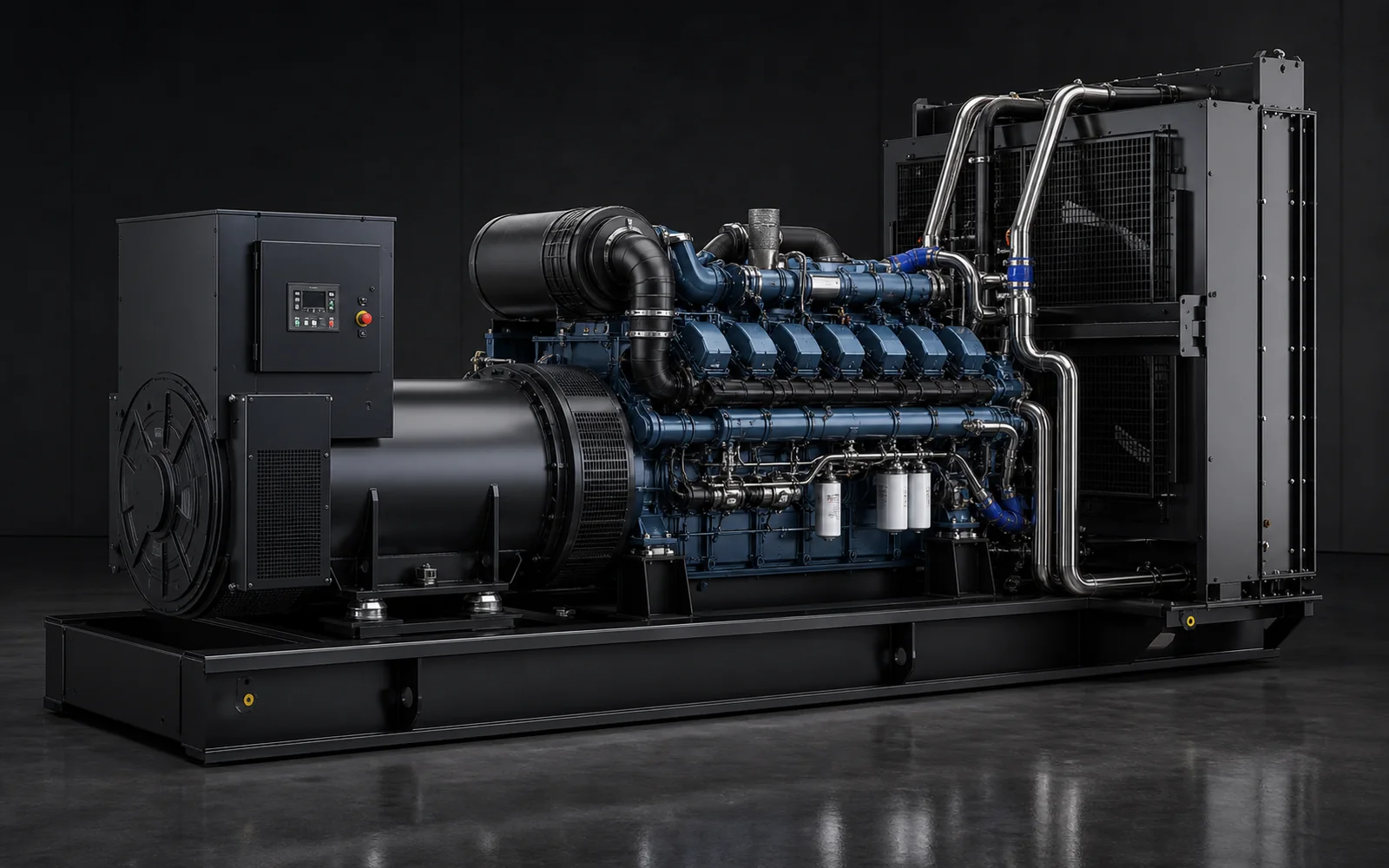
In its November 2026 coverage, Power Engineering International reported that PJM is putting generator performance at the center of its cold-weather plans, part of a late-2026 wave where operators are re-checking whether on-site generation will actually start when the grid fails. One failure mode gets less attention than the engine itself: the diesel sitting in the tank. A standby set that ran perfectly last year can refuse to start, or stall under load, because the fuel degraded while it waited. This guide explains what happens to stored diesel, how to verify it is still fit for use before you depend on it, and when to walk away from fuel you cannot prove is clean.
What actually happens to diesel fuel when it sits in a tank for months?
Conclusion first: diesel is stable, but it is not inert, and a storage tank is not a sealed bottle. Every day-night temperature swing makes the tank 'breathe' through its vent, pulling humid air in and letting it condense into free water at the bottom. That water layer is where microbial colonies - bacteria, yeasts and fungi that operators call the 'diesel bug' - grow by feeding on the fuel. At the same time, slow oxidation and reactions with dissolved metals form gums, varnishes and fine sediment. None of this shows when you look at the clean fuel near the top of the tank. The result is a set that cranks but will not fire, or fires and then clogs its filters and stalls the moment you ask it for real load.
Does a little water or haze in my diesel mean the fuel is bad?
Not automatically - and this is where buyers waste money both ways. A faint haze or a film of water is common in fuel stored for many months, and it is not in itself proof the fuel is unusable. What matters is whether free water and active microbial colonies are present, and whether the fuel still meets the applicable specification. The useful question is not 'does it look perfectly clear' but 'does it still pass ASTM D975 and is microbial activity under control'. Treat a visual glance as a warning sign, never as a pass.
How do I verify stored diesel is still good before I rely on it?
Run this checklist, and treat any step you cannot document as unfinished. (1) Sample from the bottom of the tank, not the top - that is where water and sludge collect. (2) Send the sample to a fuel-testing laboratory and request testing against ASTM D975 (the diesel fuel specification covering cetane, distillation, water and sediment, and clarity) and a microbial test per ASTM D6469 or your local equivalent, plus a particle count per ISO 4406 or local equivalent. (3) Require the lab report to state water content, the microbial result, and a pass or fail against the applicable specification; set your rejection threshold in the contract before you buy. (4) Draw off a sample at the tank bottom drain and look for persistent free water or sludge; if present, filter or polish before use. (5) Run the set under a real load - see the commissioning and load-acceptance guidance at https://linkpowergenset.com/en/news/generator-commissioning-checklist/ - not just at idle, and watch for filter clogging, heavy smoke or unstable frequency. (6) Keep a fuel log with each test date and result, and make periodic testing a written term in any service agreement.
When should I walk away from fuel or a used set I cannot verify?
Walk away if any of these show up. Walk if a supplier fills the tank 'for free' but will not provide a fuel specification or a lab report, or refuses to put fuel quality in the contract. Walk from a used or rental set offered 'with fuel included' but carrying no fuel history and no test - treat that fuel as unknown and budget to drain and replace it. Walk if the tank bottom shows free water, sludge or heavy haze and the seller says 'just run it, it's fine'. Walk if someone dumped biocide in but did nothing after - dead biomass still clogs filters. And walk if a warranty excludes fuel-related damage without saying so; require that clause in writing before you pay - see the warranty-coverage guide at https://linkpowergenset.com/en/news/generator-warranty-coverage/.
Does fuel polishing fix bad diesel, or just clean it?
Polishing cleans; it does not reverse damage. A fuel polisher recirculates the diesel through water separators and fine filters to pull out free water and particulates. That is genuinely useful as prevention, run on clean-ish fuel on a scheduled basis. It is not a cure for fuel that has badly oxidized or for an active microbial bloom - those need a biocide, and often a tank clean-out, before polishing does any good. Polishing heavily contaminated fuel is a stopgap that buys time, not a reset button. Ask the supplier what the polisher actually removes and what it does not, and write the service scope into the contract.
How does LINKPOWER handle fuel at the factory and on the project?
LINKPOWER builds diesel generator sets across open, silent, mobile-trailer and containerized packages, powered by Weichai, Yuchai and SDEC engines - see the product range at https://linkpowergenset.com/en/products/ and the engine builds at https://linkpowergenset.com/en/products/weichai-diesel-generator/, https://linkpowergenset.com/en/products/yuchai-diesel-generator/ and https://linkpowergenset.com/en/products/sdec-diesel-generator/. New fuel supplied with a set meets the applicable specification at the factory; require that specification in the quotation and confirm it at the factory acceptance test at https://linkpowergenset.com/en/factory/. Once the set is on your site, fuel condition becomes your responsibility - that is normal, not a loophole. For how tank size and built-in fuel capacity affect your autonomy, see the fuel-tank-sizing guide at https://linkpowergenset.com/en/news/generator-fuel-tank-sizing/. For critical standby sites such as hospitals, where a no-start is not an option, build fuel testing into the maintenance plan from day one - see https://linkpowergenset.com/en/applications/hospital/. If you are weighing fuel types, the diesel versus HVO comparison at https://linkpowergenset.com/en/news/diesel-vs-hvo-generator/ and the low-load wet-stacking guide at https://linkpowergenset.com/en/news/generator-low-load-wet-stacking/ cover the other sides of the fuel decision.
The practical takeaway
Stored diesel fails quietly, and it fails at the worst moment. Before you trust a standby set: sample from the tank bottom, get a lab report against ASTM D975 with a microbial and particle check, set your rejection threshold in the contract, and run the set under load, not idle. Walk from any fuel or used set you cannot test. Keep fuel quality, emissions stage and warranty separate - each must be verified and written down. Start from the product range at https://linkpowergenset.com/en/products/ and the factory process at https://linkpowergenset.com/en/factory/.
FAQ
How often should I test stored standby-generator fuel? Common practice is at least once a year and again before any season when the set is most likely to be called on, but your insurer, the authority having jurisdiction or a local code may set a specific cadence. Require the testing interval in the service contract rather than assuming it.
Can I just add biocide and forget it? No. A biocide knocks back microbial growth, but the dead biomass and any free water remain in the tank and will still clog filters. Follow the biocide with filtration or polishing and a lab re-test before you call the fuel fit.
Does stored fuel affect my emissions stage or my warranty? Fuel quality changes combustion and soot, but emissions-stage certification is a separate document - request and verify it on its own at https://linkpowergenset.com/en/news/verify-generator-emissions-stage/. Warranties often exclude damage caused by contaminated fuel; require that exclusion, or its absence, in writing at https://linkpowergenset.com/en/news/generator-warranty-coverage/.
What we need from you
Send your duty (prime or standby), running and motor-starting load, voltage and frequency, enclosure preference, required autonomy, fuel type and the fuel-test cadence you want. LINKPOWER confirms the selection, states the applicable fuel specification in the quotation, and documents the factory acceptance test against your stated requirements. Start from the product range at https://linkpowergenset.com/en/products/, the engine builds, or the factory process at https://linkpowergenset.com/en/factory/.