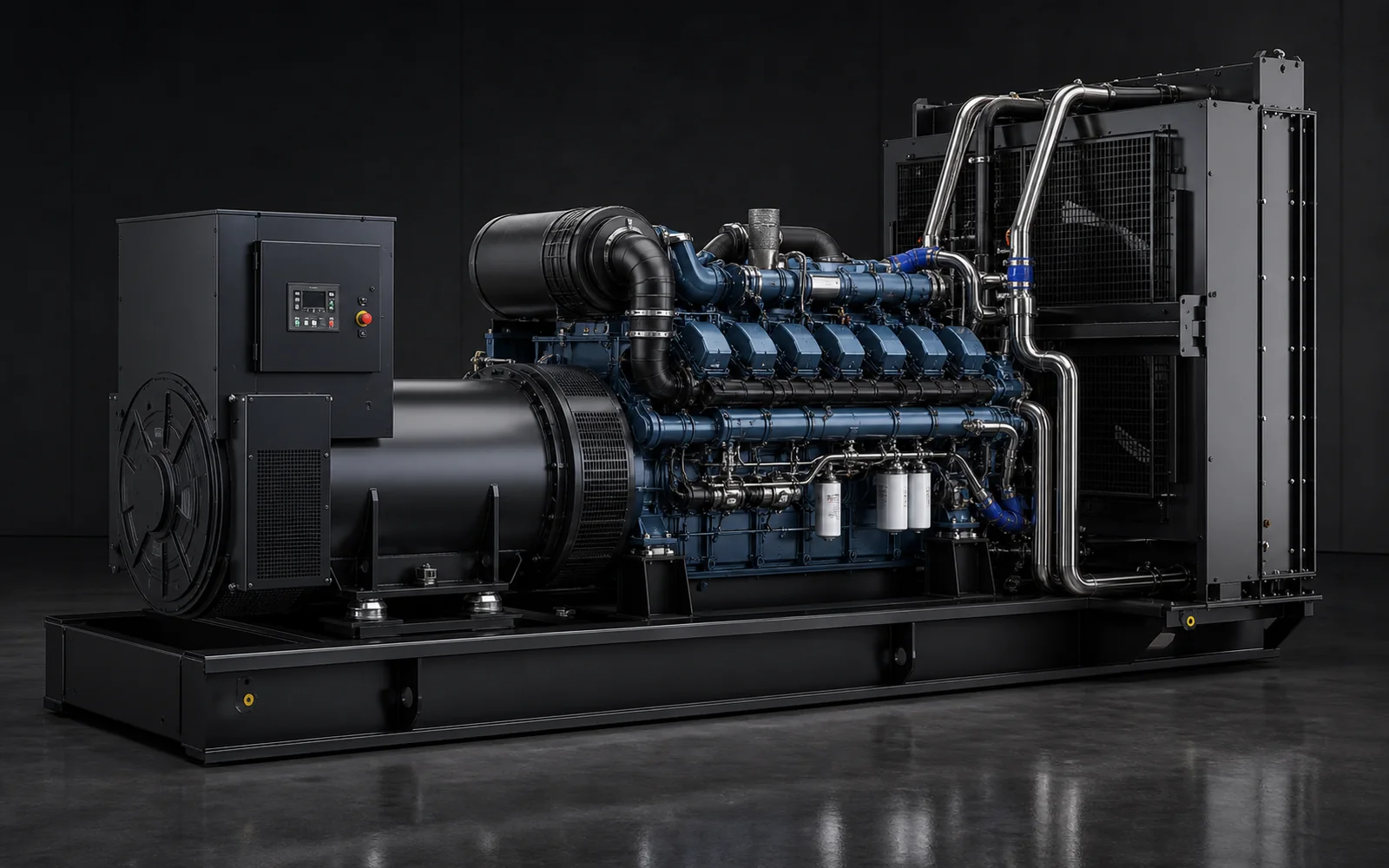
On 2026-10-31 Power Engineering International reported that keeping aging combined-cycle plants serviced is getting harder as the fleet ages (https://www.power-eng.com/operations-maintenance/maintaining-an-aging-combined-cycle-plant-aint-what-it-used-to-be/). When a plant cannot rely on its own auxiliary systems, a standby diesel set that can actually start the big motors - pumps, fans, compressors - becomes the difference between a short hiccup and a long outage. This guide explains why generators trip when a motor starts, why a bigger kVA plate is not the same as a confirmed motor start, and the checks that prove the set will start your load before you pay.
Why does my generator stall or trip when a motor starts?
The single most common cause of a genset that runs fine on no-load but trips the instant a motor starts is undersized motor-starting capacity, not a weak engine. A motor draws a large inrush current the moment it is energized - for many motors this is several times the running current, and the exact multiple comes from the motor's locked-rotor data, not a guess. That inrush collapses the generator terminal voltage and drops the frequency; if the dip goes past what your controls or connected equipment tolerate, the breaker trips or the motor fails to accelerate. The engine may have plenty of power; the alternator and the starting sequence are what decide whether the motor reaches speed.
Does a higher kVA rating mean my motor will start?
Not by itself, and this is the gap most buyers miss. The nameplate kVA tells you the continuous rating at a defined power factor; it does not tell you the alternator's subtransient reactance, the step-load acceptance, or how much voltage dip the set allows under a locked-rotor load. A set with a higher kVA but a soft alternator can dip harder than a correctly matched smaller set. What actually matters is the combination of starting method, alternator design, governor response and the voltage-and-frequency tolerance your site accepts. A supplier who quotes only kVA and promises 'it will start your motor' has not done the calculation - ask for it in writing.
How do I verify the genset will start my motor before buying?
Put the following on the RFQ and refuse a one-line 'yes' as the answer: (1) A load schedule that lists every motor with its running kW, locked-rotor kVA and starting method. (2) The starting method for each large motor - direct-on-line, star-delta, soft starter or variable-frequency drive - because each changes the inrush the set must absorb. (3) The acceptable transient voltage and frequency dip for your site, confirmed with your equipment maker or the applicable site requirement. (4) The alternator subtransient reactance and step-load acceptance figure from the alternator data. (5) A motor-starting calculation from the supplier that shows the set holds the dip within tolerance through the starting sequence (https://linkpowergenset.com/en/products/). (6) Confirmation the set is built and tested for the duty - LINKPOWER issues the motor-starting calculation against the confirmed engine and alternator data and runs the set through step-load acceptance at the factory before shipment (https://linkpowergenset.com/en/factory/). A supplier who cannot produce the calc is asking you to discover the trip on commissioning day.
When should I walk away from a supplier on motor-starting claims?
Walk, or pause hard, if the supplier quotes a kVA with no motor list, refuses to state the voltage dip the set will hold, will not name the alternator or its subtransient reactance, or insists 'any set this size starts motors' without a calculation. Also walk if they recommend direct-on-line starting on a large motor while declining to confirm the alternator and governor can take the locked-rotor load, or if the quote silently assumes a soft starter you have not specified. Any one of these missing in writing is enough to slow the order - a genset that trips on first motor start is an asset you cannot trust during the blackout it was bought for.
The practical takeaway
Size for the starting sequence, not the running load: send the motor list with locked-rotor data and starting method, confirm the acceptable dip with your equipment maker, and get the supplier's motor-starting calculation in writing before you pay. Read how a complete RFQ captures this up front and where motor starting fits the full selection (https://linkpowergenset.com/en/news/how-to-size-a-diesel-generator/) (https://linkpowergenset.com/en/news/generator-rfq-checklist/). LINKPOWER builds diesel generator sets on Weichai, Yuchai and SDEC engines across open, silent, mobile and containerized formats, and issues a motor-starting calculation against the confirmed alternator and governor so the set you receive is proven to start your load, not assumed to (https://linkpowergenset.com/en/products/) (https://linkpowergenset.com/en/factory/). The set you can prove on paper is the set that starts on site.
FAQ
Does a soft starter or VFD remove the need to size for motor starting? No. A soft starter or VFD cuts the inrush the genset must absorb, often dramatically - but you still need the supplier's calculation for the reduced current, and you must size the set for the drive's own input characteristic. Reduced starting does not let you skip the motor-starting check; it changes the numbers in it.
What voltage dip is acceptable during motor start? That depends on your connected equipment and any site or utility requirement, so confirm it with the equipment maker rather than trusting a fixed rule. The supplier's job is to prove the set holds your agreed dip through the starting sequence - if they will not state the tolerance, you have no basis to accept the set.
Can one generator start several motors one after another? Usually yes, if the starting sequence is staged so only one large motor accelerates at a time and the set recovers between starts. Send the full sequence - not just the largest motor - so the calculation covers recovery, not just the first start. Staging is cheaper than oversizing and is part of a proper selection.
What we need from you
Send your load schedule with every motor's running kW, locked-rotor kVA and starting method, your acceptable voltage and frequency dip, and the duty (standby or prime) with expected run hours. We return a motor-starting calculation against the confirmed engine, alternator and governor, plus the step-load acceptance result from factory test, so you can verify the set starts your load before the order - not during your first outage. Start from the full product range (https://linkpowergenset.com/en/products/) and the factory build and test process (https://linkpowergenset.com/en/factory/).