Rent or buy? It is the first question every buyer asks once they know they need on-site power, and the answer changes with the job. Through late October 2026 the pressure pushing sites toward self-generation has not let up - Power Engineering International's coverage of the Black Hills 564 MW build and 2.1 GW microgrid managed for a Google data center in Wyoming (dated around 2026-10-26) is one more sign that both temporary and permanent power gaps are opening faster than the grid can close them. That same gap is what rental fleets and factory-built sets both sell into. This guide tells you how to pick the right route before you sign, how to make two quotes comparable, and the warning signs that a deal is not worth touching.
What is actually the difference between renting and buying a generator?
The short version: renting means you pay for use over a period and the supplier keeps ownership, delivers, services and collects the set; buying means you pay capital, you own the machine, and you carry service and compliance in your own name. The hard fact buyers miss is that the identical kW set can be quoted both ways, and the two numbers are only comparable if the rating basis, fuel basis and what-is-included list are identical. A rental quote that looks half the price of a purchase may simply exclude fuel, cables, transport and the sound enclosure you are legally required to have. Compare like for like, or you are comparing two different products.
Does renting really cost less, or just move the cost to later?
It depends on duration, and the breakeven point is exactly the number most quotes avoid stating. For a one-off or short need - a few weeks to a few months - rental keeps your cash free and hands service back to the supplier, which is genuinely cheaper on cash flow. For continuous or recurring multi-year duty, daily or monthly rental rates accumulate past the purchase price, and owning wins. Do not accept a sales claim of 'cheaper' on either side. Ask each supplier for a total-cost figure over your actual horizon: rental rate x days vs purchase price plus fuel, scheduled service and your own finance cost. Put the breakeven in writing. No fixed number belongs in this article, because duty cycle, local fuel price and rental rates vary by market and by week.
Which jobs actually call for renting a generator?
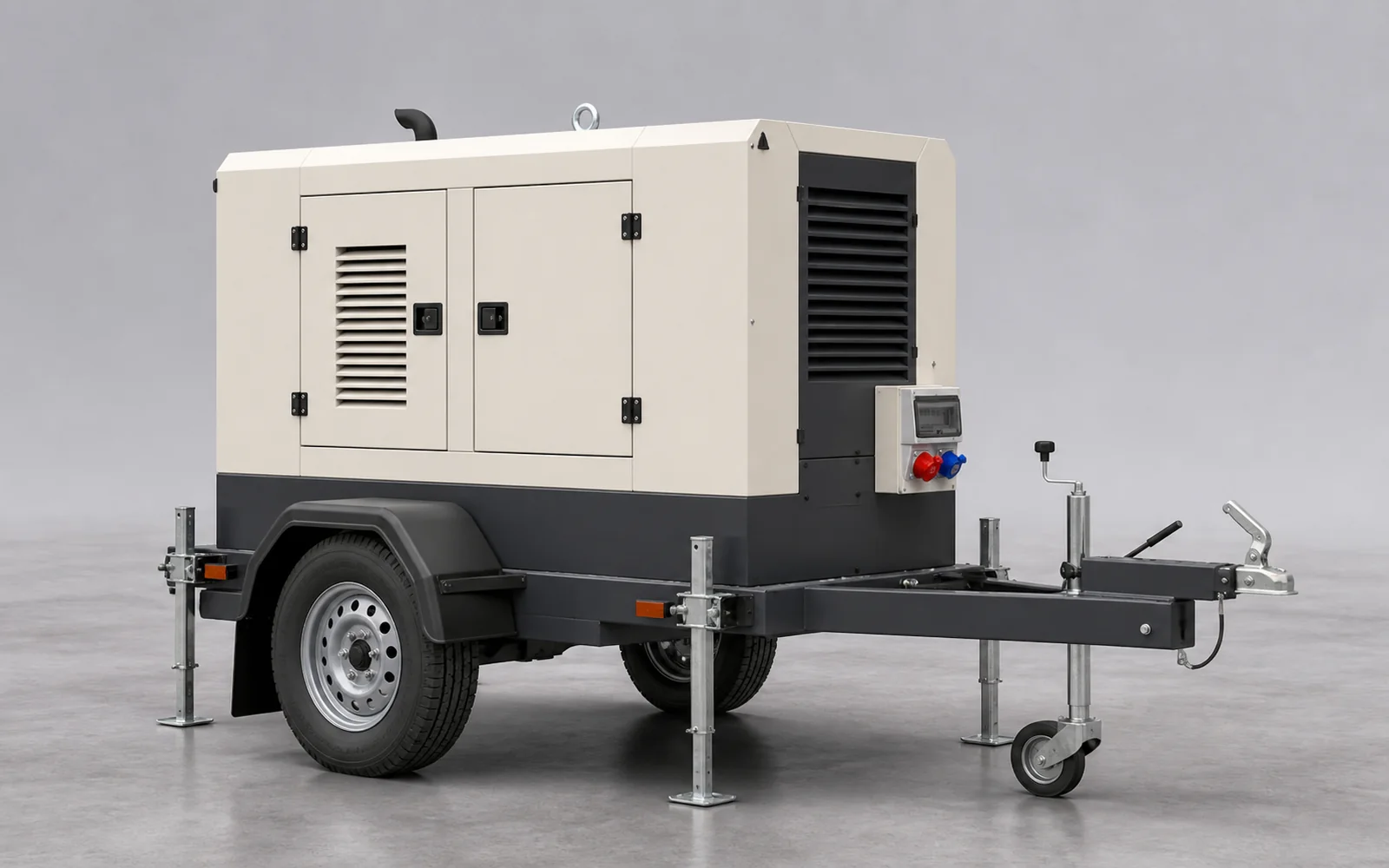
Rent when the need is temporary or uncertain. The clear fits are event power, emergency backup during an outage or planned grid work, a construction power spike, and bridge cover while a permanent set is being built, repaired or commissioned. On permitted or urban sites, a quiet trailer-mounted or silent-enclosed set does the job without a noise complaint (https://linkpowergenset.com/en/products/mobile-trailer-generator/, https://linkpowergenset.com/en/products/silent-diesel-generator/). Construction crews rely on exactly this pattern (https://linkpowergenset.com/en/applications/construction/). Rental is the wrong answer when you need continuous prime power for years, when your permit requires emission or sound certificates held in your own name, or when downtime would stop a process you cannot pause - owning gives you control and a known spare-parts path that a rental contract rarely guarantees beyond the rental term.
When does buying beat renting?
Buy when the duty is recurring or long-term, when you need a set built to your exact load, voltage, frequency and enclosure, and when you want a factory acceptance test and a warranty you control. A purchased containerized or permanent set (https://linkpowergenset.com/en/products/containerized-power-system/) becomes a fixed asset you size once and run for a decade. Buying is also the only route that lets you specify the engine brand and the compliance documents your market requires, and keep them on file as the asset owner. If you will need power in the same place next year and the year after, the math and the control both point to ownership.
How do I verify a rental or purchase quote before committing?
Make every quote answer the same eight questions, and refuse to compare any two that do not: (1) Rating basis - is the kW prime or standby? A standby-rated set priced as prime is a trap; insist both quotes state which (https://linkpowergenset.com/en/news/). (2) Fuel consumption basis - at what load percentage, and is it measured or estimated in L/h? (3) Lead time or availability date - for purchase, the production plus test plus shipping window; for rental, the date the set arrives. Get it in writing, not as 'we can do soon.' (4) Inclusions and exclusions - fuel, cabling, installation, transport, taxes; demand the exclusion list so nothing surfaces late. (5) Fault responsibility - during rental, who fixes and how fast; for purchase, the warranty scope and a named local service party (https://linkpowergenset.com/en/news/). (6) Compliance documents - request the emission stage, CE and sound-level dB(A) certificates applicable to your market and write them into the contract; never accept a verbal 'it's compliant.' (7) For purchase, require a factory acceptance and load-test report before crating (https://linkpowergenset.com/en/factory/). (8) Build-to-order minimums - confirm any MOQ or configuration floor for a set built to your spec.
When should I walk away from a generator quote or rental deal?
Walk away, or pause hard, if the supplier: states no rating basis at all; gives lead time or availability only verbally with no contract date; refuses to provide emission, CE or sound-level certificates for your market; offers a warranty that excludes the engine or names no local service party; reveals fuel, transport or install costs late as 'extras'; cannot show a factory test report for a purchased set; or wraps a rental in auto-renewal and punitive running-hour caps you did not spot. Any one of these missing in writing is enough to walk. A supplier that builds and exports complete packages states rating, inclusions, compliance route and lead time in the same document. One that cannot is asking you to discover the gap after you are committed.
The practical takeaway
Decide by duration and duty first, not by the headline price. Make every quote comparable on the same rating basis, fuel basis and inclusion list. Get compliance certificates and lead time on paper before you pay. Rent for short, uncertain or one-off needs; buy for recurring, long-term or compliance-critical power. LINKPOWER builds diesel generator sets as complete packages - open, silent, mobile-trailer and containerized formats across Weichai, Yuchai and SDEC engines (https://linkpowergenset.com/en/products/) - configured to your project and run and inspected in the factory before crating (https://linkpowergenset.com/en/factory/). Whether you need a trailer set for a six-week job or a containerized prime plant for a decade, the same rule applies: the quote you can verify line by line is the one worth signing.
FAQ
Can I rent a generator for data-center commissioning? Yes, rental is common for commissioning, grid-transition bridge cover and emergency backup during build-out. For permanent critical load you should buy and configure a set to your exact duty, because you will need the compliance certificates and the control that ownership provides.
What lead time should I expect when I buy? It varies with configuration, engine brand and order queue, and no honest supplier states a single global number. Ask for the production, test and shipping window in the contract, and confirm whether the set is built-to-order or from stock before you commit a project date to it.
What we need from you
Send the duty (standby or prime), how long you need power, the load and voltage, and the destination. We return a quotation that states the rating basis, inclusions, compliance route, factory test and lead time together - so you can compare it line by line against any rental or competitor offer and decide with the numbers in front of you, not after. Start from the full product range (https://linkpowergenset.com/en/products/) and the factory build process (https://linkpowergenset.com/en/factory/).