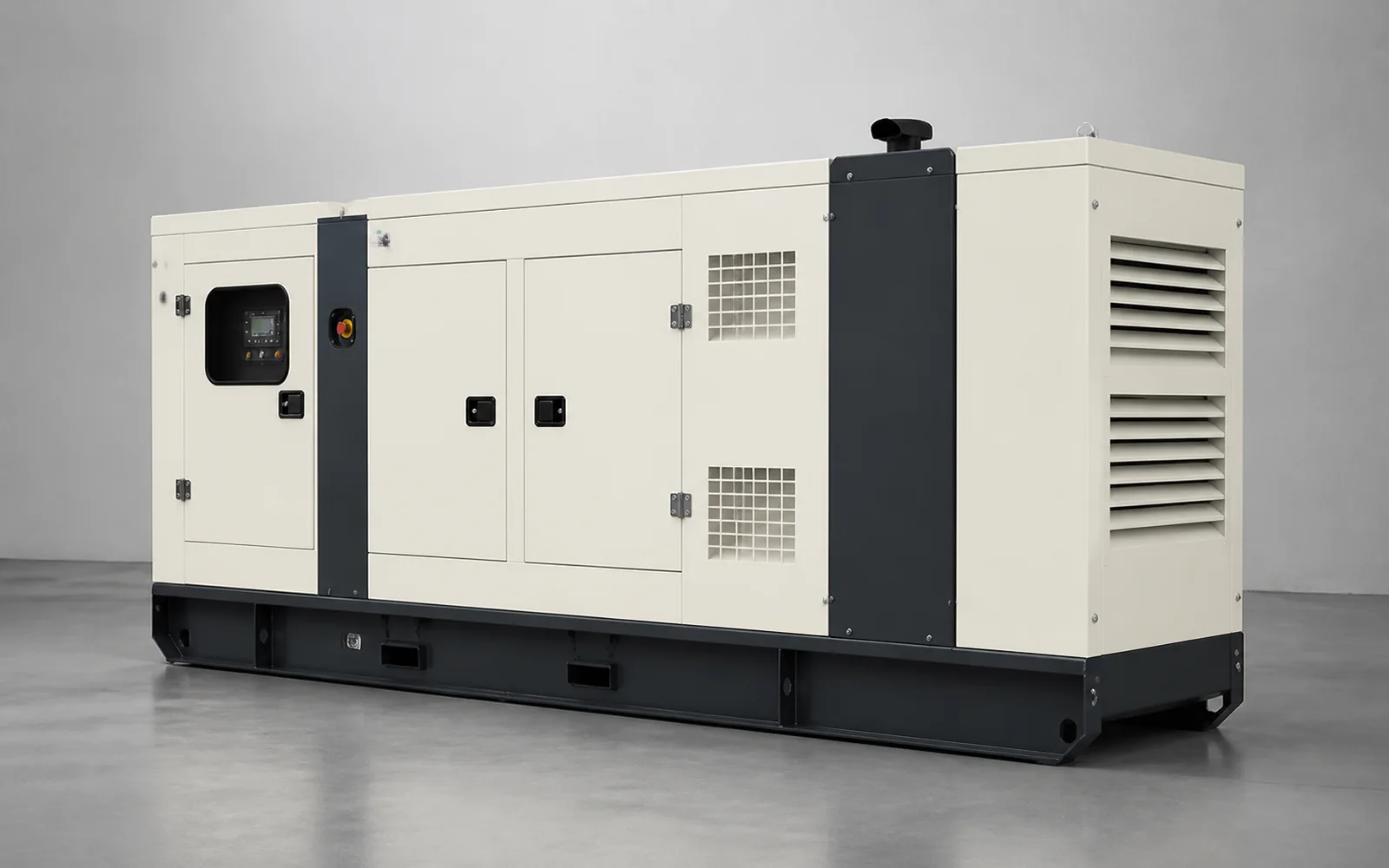
On 2026-11-05 the industry feeds were again dominated by gas turbines, grid-scale batteries and utility solar - none of it about the spec that decides whether the electricity coming off your diesel set is clean enough for the equipment you are actually powering. That spec is power quality: total harmonic distortion (THD), voltage regulation and frequency stability. Buyers routinely check kVA and fuel burn, then discover their servers, medical gear or telecom racks misbehave on a set whose voltage wanders or whose waveform is distorted. This guide explains what generator power quality actually is, why a clean nameplate kVA does not guarantee clean electricity, and the checks that prove the real output before you pay.
What does 'generator power quality' actually mean?
Conclusion first: power quality is whether the electricity a set produces matches what your loads expect - a stable voltage, a stable frequency and a clean sine wave with low harmonic distortion. Three measurable things decide it: (1) voltage regulation - how tightly the output voltage holds as load steps on and off; (2) frequency regulation - how steadily the engine speed, and therefore the frequency, holds under changing load; and (3) total harmonic distortion, or THD - how far the actual waveform deviates from a pure sine wave because of the alternator, the automatic voltage regulator and the connected loads. A set can be perfectly sized in kVA and still deliver power that trips sensitive electronics. Power quality is set by the engine governor, the alternator and the AVR working together, not by the nameplate number alone.
The international reference for this is ISO 8528-1, which defines performance classes G1 through G4 for how much voltage and frequency may vary in normal operation. G1 is for simple, non-critical loads; G2 for general applications where the variation does not harm the load; G3 for networks and systems with tighter limits, the classic telecom and medical applications; and G4 for the strictest limits on critical systems. Which class your set must meet is a project decision, and it is the single most useful question to put to a supplier - yet most quotations never state it.
Does a bigger or more expensive set automatically mean cleaner power?
No. Output cleanliness is not a function of size or price; it is a function of the governor, alternator design and AVR quality, plus how the set is loaded. A smaller set with a good digital AVR and a well-designed alternator can beat a larger set with a cheap regulator on THD and voltage hold. The claim to watch is 'high quality power' with no class stated - that phrase means nothing until it is tied to an ISO 8528-1 performance class and a measured THD and regulation figure. Size and cleanliness are separate purchase decisions, and conflating them is how buyers overpay for kVA they did not need while still getting dirty power.
How do I verify a generator's power quality before buying?
Put these on the RFQ and treat vague reassurance as unfinished: (1) Ask which ISO 8528-1 performance class the set is built and tested to (G1, G2, G3 or G4) and confirm it matches your load's requirement - telecom and medical sites are the classic G3 applications where tighter limits apply. (2) Ask the supplier to state the THD of the output at full load and at light load, in writing, together with the steady-state voltage regulation as a percentage and the transient voltage dip and recovery time under a defined load step. (3) Request the factory test report per ISO 8528-1 that shows these figures measured, not estimated (https://linkpowergenset.com/en/factory/). (4) Confirm the AVR type - a digital, self-exciting or PMG-excited regulator generally controls voltage better than a basic analog unit - and ask whether the alternator is brushless, since brushless designs avoid the wear and sparking that can add noise to the output (see how the alternator end is selected https://linkpowergenset.com/en/news/generator-alternator-selection/). (5) If your load is sensitive - hospital equipment, telecom racks, IT servers - state that in the RFQ and ask the supplier to confirm the class and THD against your actual connected load, not a generic rating (https://linkpowergenset.com/en/applications/hospital/ and https://linkpowergenset.com/en/applications/telecom/). (6) Require the confirmed class, THD and regulation to be written into the contract and the acceptance test, so the number you were quoted is the number you receive.
When should I walk away from a 'clean power' claim?
Walk if the supplier answers 'our generators have good power quality' with no ISO 8528-1 class named. Walk if THD and voltage regulation are refused in writing or only given as a marketing range with no test report behind them. Walk if the set is quoted for a hospital or telecom site but the performance class is never stated - those loads are exactly where G3 matters. And walk from any seller who conflates kVA with cleanliness, because sizing you up while staying silent on THD is how you end up with a set that runs your motors fine but crashes your electronics.
The practical takeaway
Power quality is voltage stability, frequency stability and low THD - decided by the governor, alternator and AVR, not the nameplate kVA. Before you sign, get the ISO 8528-1 performance class in writing, the measured THD and voltage regulation from a factory test report, and the AVR and alternator type confirmed. Match the class to your load - G3 for telecom and medical - and write it into the contract and acceptance test. Browse the product range (https://linkpowergenset.com/en/products/), the factory test process (https://linkpowergenset.com/en/factory/), and related reads on the alternator (https://linkpowergenset.com/en/news/generator-alternator-selection/) and on voltage dip during starting (https://linkpowergenset.com/en/news/generator-sizing-for-motor-start/). LINKPOWER builds open, silent, mobile and containerized sets and documents the tested power-quality figures with the order so the electricity is proven clean for your load before it ships, not assumed.
FAQ
Is THD the only thing that matters for sensitive equipment? No. Voltage and frequency stability under load steps matter just as much - a set with low THD but a slow AVR can still let voltage sag when a load kicks in. Ask for all three: class, THD and regulation.
Can I fix dirty power with an external filter after delivery? Sometimes, with an online UPS or isolation transformer, but that adds cost, space and a single point of failure - and it does not fix a weak AVR's slow recovery. Specifying the right performance class up front is cheaper than bolting correction on later.
Does power quality depend on how hard the set is running? Yes. THD and voltage hold usually change between light load and full load, which is why you should ask for the figures at both ends, not just at rated output. A set that is clean at 100 percent can behave worse at 20 percent.
What we need from you
Send your load type (especially whether it is sensitive - IT, medical, telecom), required kVA and voltage, frequency, and any performance class your site or authority requires. We confirm the ISO 8528-1 class the set is built and tested to, state the measured THD and voltage regulation from the factory test, and supply the test report with the order. Start from the product range (https://linkpowergenset.com/en/products/), the factory process (https://linkpowergenset.com/en/factory/), or the applications we configure for - hospital (https://linkpowergenset.com/en/applications/hospital/) and telecom (https://linkpowergenset.com/en/applications/telecom/). You can also review how the control and AVR are verified (https://linkpowergenset.com/en/news/generator-control-panel-verification/).