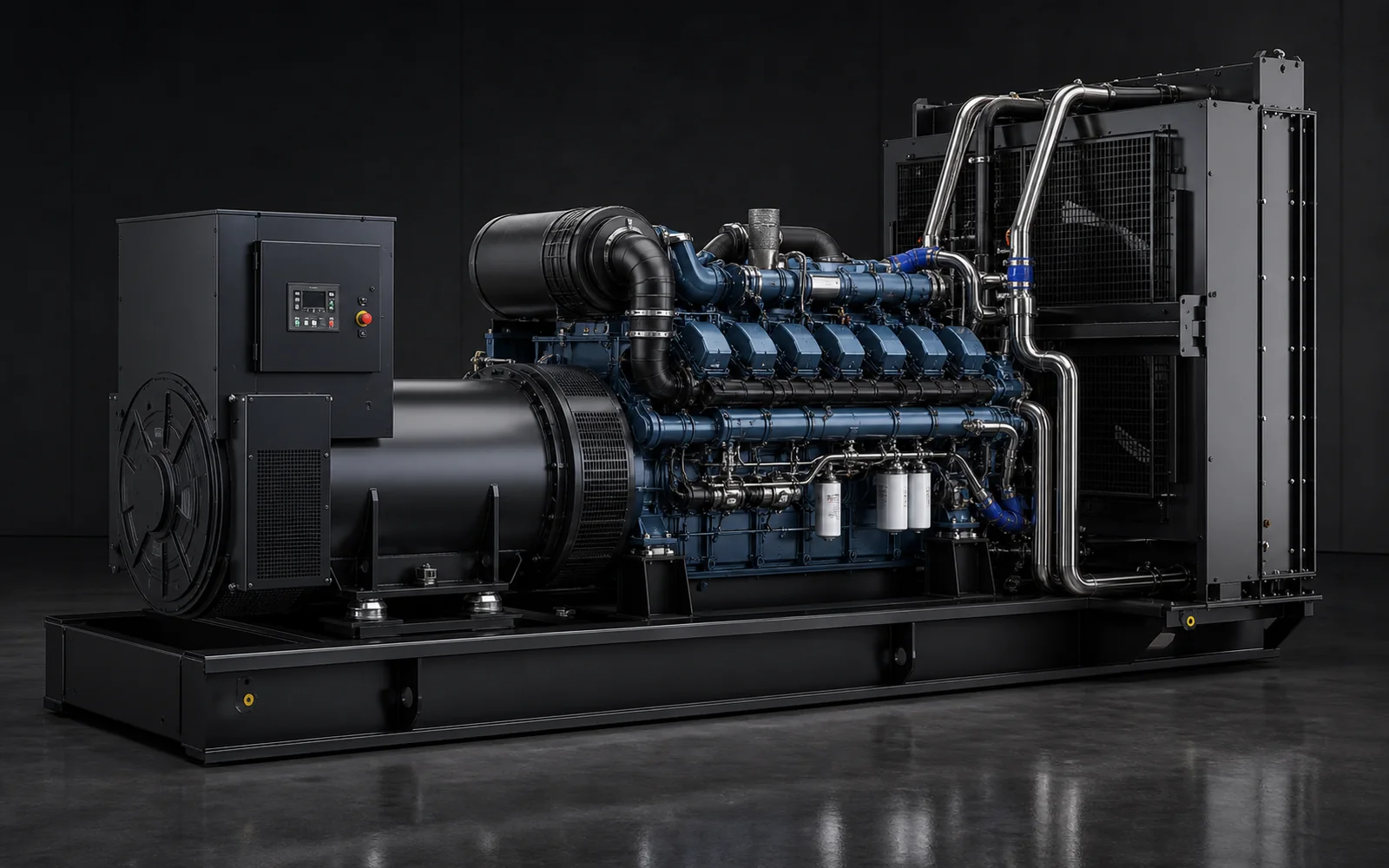
A standby generator spends most of its life doing nothing, then has to start first time during a blackout, a storm or a grid fault. That is the hardest duty a machine can face: long idle, then a sudden full load with no warm-up. Maintenance is the only thing that keeps that gap from becoming a failure. This checklist is written for owners, facilities managers and anyone buying a set who wants a service list they can actually run, or hand to a contractor and verify afterwards.
Daily and weekly checks you can do without tools
Walk the set and look before you touch anything. Check for fuel, coolant or oil leaks under the base, confirm the control panel shows no active alarm, and make sure the battery charger indicator reads healthy. For a set on automatic standby, the maker's manual sets the exercise interval and duration - run a short start on that schedule and record that it cranked and took load. There is no single correct interval that fits every engine, so follow the manual and keep the log; the log is what proves the set was looked after if a claim or warranty question comes up later.
Monthly: fluids, belts, battery and the nameplate
Check coolant level and concentration, oil level and condition, and drive-belt tension. For the battery, read voltage and, on flooded cells, specific gravity; on sealed VRLA cells, confirm state of charge from the charger. Tighten the terminal connections. While you are there, read the nameplate and confirm the protection marking printed on it - often an IP code - still matches where the set actually sits. If the set was moved or the building was altered, ask the supplier for the test certificate that supports that marking instead of assuming it still applies. Open-type sets put every one of these service points within arm's reach, which is part of why they suit engineered plant rooms: https://linkpowergenset.com/en/products/open-type-generator/.
Before the high-risk season: load test and fuel condition
Diesel that sits in a tank grows water and microbes, and a lightly loaded engine never reaches the temperature that burns off condensation - the usual cause of wet-stacking and poor starts. Run a loaded exercise, ideally on a load bank, to bring the engine up to its working temperature; the duration and load level should follow the engine maker's guidance, not a guess. Sample stored fuel and treat it on the fuel supplier's advice. For enclosed outdoor sets, add the acoustic enclosure and the integral fuel tank to the walk-around - both need their own inspection that the open set does not. The factory application notes tie these checks to the load profile and site conditions of an industrial installation: https://linkpowergenset.com/en/applications/factory/.
Electrical and protection checks a competent technician should sign
A qualified technician should tighten connections, test automatic transfer to and from the utility, and verify voltage and frequency stay inside the maker's limits during step loading. Do not estimate protection ratings from appearance - confirm the enclosure IP code and any applicable compliance documents with the supplier, because the right number depends on the installed environment. The same technician should read the alternator and control settings against the commissioning report so a later service does not quietly drift the configuration.
Keep the paper trail: documents to request from the supplier
Maintenance is half paperwork. Ask the supplier for the engine and alternator service manuals, the as-tested commissioning report from the factory, a spare-parts list, and the applicable emission-stage and compliance documents for your destination market - request these rather than assuming they travel with the machine. With those in hand, any local workshop can service the set and you can check the contractor's work against the same numbers. LINKPOWER builds and tests each set at the factory and ships the as-tested report with the unit: https://linkpowergenset.com/en/factory/.
FAQ
How often should a standby generator be exercised? Follow the engine and alternator maker's manual and any local code; many sites run a short weekly start, but the correct interval is the one the manufacturer states for your model, logged each time. A log kept over months is worth more than a remembered schedule.
Can I service a diesel generator myself? Basic visual checks and reading the panel are fine for an owner. Anything that opens the electrical, fuel or exhaust system should go to a competent technician, and the supplier should provide the service manual and recommended intervals so the work is repeatable.
What documents prove a generator was properly tested? The factory as-tested commissioning report and the engine and alternator run logs are the core evidence. For your market, also request the applicable emission-stage and compliance documents from the supplier rather than assuming they are covered - treat them as papers to obtain, not properties to assume.
Send us your duty, site conditions, fuel plan and the documents your market requires, and LINKPOWER will return a configuration - open, silent, trailer or containerized, on Weichai, Yuchai or SDEC engines - with the verification papers and export plan stated up front. Because the sets are built and tested at our own factory, the as-tested report travels with the unit, so your local technician services the exact machine you received. See the full range: https://linkpowergenset.com/en/products/.