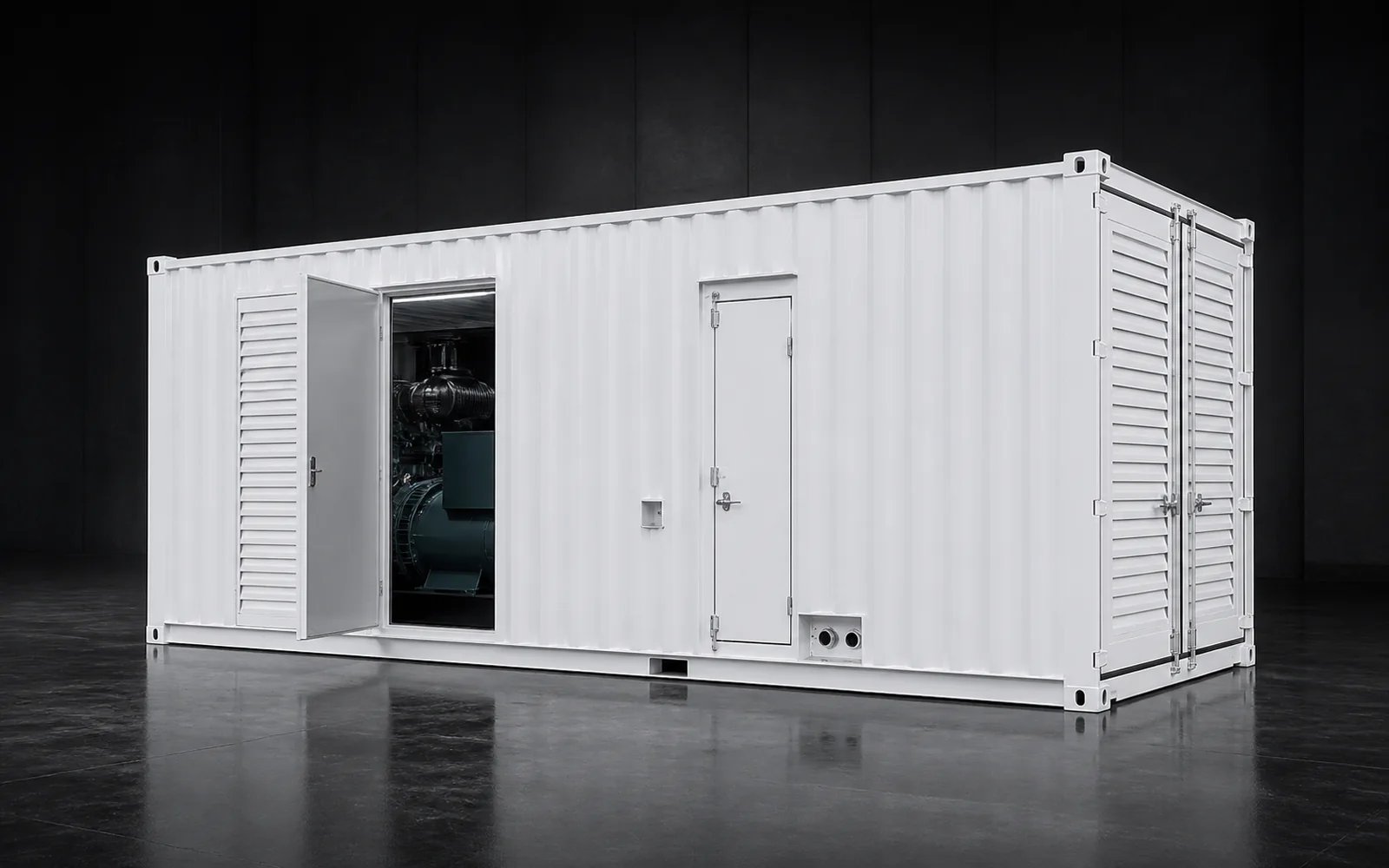
On 2026-11-04 the industry feeds were again dominated by gas turbines, solar farms and batteries - none of it about the spec that quietly decides whether your diesel set delivers its nameplate power on the day you need it. That spec is derating: the loss of output at altitude and high ambient temperature. Buyers routinely size a set from the brochure's sea-level, 25-degree number, then watch it fall short on a 2,000 m site or in a 40-degree summer. This guide explains what derating actually is, why the nameplate is only half the story, and the checks that prove the real rating before you pay.
What does 'derating' actually mean for my generator's nameplate power?
Conclusion first: the kVA and kW printed on the nameplate are rated at a reference site - roughly 100 kPa atmospheric pressure, 25 degrees C and 30 percent relative humidity under ISO 8528-1 and ISO 3046 - not at your site. As you go up in altitude the air gets thinner, the engine ingests less oxygen per stroke and makes less power; as ambient temperature rises the air also thins and the cooling system works harder. Both effects cut the output the set can sustain. Derating is the correction from the reference number to what your actual location allows, and it is the difference between a set that carries your load and one that trips on overload when the heat is on.
The trap is that the nameplate almost never shows the corrected number. A 500 kVA set rated at the reference site may not deliver 500 kVA at 2,000 m and 40 degrees C. If you bought for 500 kVA, you now own an undersized set with no paper trail saying otherwise - because nothing in the standard brochure promised the altitude number.
How much power do I lose at altitude and in hot weather?
Short answer: it depends on the engine, the aspirating method and how far your site sits from the reference conditions - so do not trust a single rule-of-thumb percentage quoted in a proposal. Most diesel engines lose output as air density drops, often several percent per 1,000 m and a further smaller percentage per 5 degrees C above the reference, but the exact curve is engine-specific and changes between naturally aspirated, turbocharged and altitude-compensated builds. The only number that matters for your order is the manufacturer's site-correction curve, referenced to the ISO 8528-1 and ISO 3046 reference conditions. Read how we size to your actual duty (https://linkpowergenset.com/en/news/how-to-size-a-diesel-generator/) so the starting current does not compound the altitude penalty.
Note the two effects stack. A site that is both high and hot loses more than either condition alone, and the cooling system's own capacity also falls as incoming air warms, so the alternator's temperature rise and the radiator's margin both tighten. A set that is marginal at sea level in spring can be clearly undersized on a high plateau in summer - exactly when you need it most.
Where this bites hardest is mining and infrastructure work: pits and mountain roads sit at 1,500 to 4,000 m, where the uncorrected nameplate can overstate available power by a wide margin (https://linkpowergenset.com/en/applications/mining/). The same logic applies to desert and tropical infrastructure projects where 40 to 50 degrees C ambient is the norm, not the exception (https://linkpowergenset.com/en/applications/infrastructure/).
Does a 'high-altitude rated' set mean I can skip the correction?
No. A set described as 'high-altitude' or fitted with an altitude kit is usually a standard engine with a turbocharger, different fuel mapping or a larger air intake to recover some lost output - it is not exempt from physics, and it is still rated against a defined reference. What the label should tell you is the corrected output at a stated altitude and temperature, not a free pass to ignore the curve. If a supplier says 'this is our altitude model' without giving the corrected kVA at your exact altitude and ambient, you have a slogan, not a rating. Confirm whether the engine is Weichai, Yuchai or SDEC and ask for the corrected output for that specific engine at your site (https://linkpowergenset.com/en/products/weichai-diesel-generator/).
How do I verify the real rating before buying?
Put these on the RFQ and treat a bare nameplate number as unfinished: (1) Ask for the rated output at the ISO 8528-1 and ISO 3046 reference conditions AND the corrected output at your site's altitude and maximum ambient temperature - two numbers, not one. (2) Request the manufacturer's site-correction curve (altitude versus output, and temperature versus output) for the exact engine model, so you can read the penalty yourself. (3) State the prime or standby rating you are buying and confirm which one the corrected figure uses, because prime and standby have different allowable overload and running-hour limits. (4) Confirm the alternator's packaged rating after the enclosure cooling penalty, because a silent or containerized set's electrical end is also affected by incoming air temperature - see how the electrical end is rated (https://linkpowergenset.com/en/news/generator-sizing-for-motor-start/). (5) Require the corrected rating to be written into the contract and the acceptance test, and insist the factory load test runs at or simulates your altitude and ambient envelope, not just the reference bench. (6) LINKPOWER builds open, silent, mobile and containerized sets (https://linkpowergenset.com/en/products/) and configures the engine and cooling to the project's altitude and climate, runs the load acceptance at the corrected rating, and supplies the site-correction curve and test report with the order so the real number is documented, not assumed (https://linkpowergenset.com/en/factory/).
When should I walk away from a derating claim?
Walk if the quotation gives one kVA number with no reference conditions - you cannot verify what the number assumes. Walk if the supplier refuses to provide the engine's site-correction curve and instead quotes a flat 'no derating up to X meters' with no data behind it. Walk if prime and standby are used interchangeably so you cannot tell which rating the corrected figure is. And walk from any seller who says 'altitude kit, so it's fine' without a corrected output at your altitude and temperature - that is a sales line covering an uncalculated shortfall.
The practical takeaway
The nameplate is a reference-site number, not your number. Before you sign, get the corrected output at your altitude and hottest day, referenced to ISO 8528-1 and ISO 3046, backed by the engine's own site-correction curve, and written into the contract and the acceptance test. Size from the corrected figure, not the brochure, and confirm the alternator's packaged rating moves with it. Compare the product range (https://linkpowergenset.com/en/products/) and the factory test process (https://linkpowergenset.com/en/factory/), and read the full sizing method (https://linkpowergenset.com/en/news/how-to-size-a-diesel-generator/). LINKPOWER documents the corrected rating with the order so the set is proven for your site before it ships, not discovered short after it trips.
FAQ
Is derating the same for every generator? No. The penalty depends on the engine's aspiration (naturally aspirated loses more than turbocharged), the cooling system margin, and how far your site is from the reference conditions. The only figure that applies to your order is the engine maker's site-correction curve at your altitude and ambient - ask for it in writing.
Can I just buy a bigger set to cover the loss? You can, but sizing blind by adding a flat percentage wastes money and space, and may still miss the mark if the alternator or cooling is the limiting item rather than the engine. The right move is to size from the corrected rating the supplier actually commits to, then add the starting-duty margin your motors need.
Does the alternator derate too, or just the engine? Both. The engine loses power as air thins, and the alternator and radiator lose margin as incoming air warms, so the packaged rating of a silent or containerized set is set by the combined envelope. Confirm the packaged electrical output at your conditions, not just the engine's mechanical number.
What we need from you
Send your site altitude, maximum ambient temperature, required output (prime or standby), voltage and frequency, and the largest motor and its starting method. We confirm the corrected rating for the chosen engine at your conditions, select the cooling and aspiration, state the packaged output after the enclosure penalty, and supply the site-correction curve and factory test report with the order. Start from the product range (https://linkpowergenset.com/en/products/), the factory process (https://linkpowergenset.com/en/factory/), or the applications we configure for - mining (https://linkpowergenset.com/en/applications/mining/) and infrastructure (https://linkpowergenset.com/en/applications/infrastructure/).