A power cut on a farm is not an inconvenience you wait out. Milk in a cooling tank spoils within hours, an irrigation pump that stops mid-cycle can strand a crop, and livestock ventilation that fails on a hot day becomes an emergency fast. The right generator set turns those losses into a brief, recoverable pause. This guide covers how to choose and verify a farm generator without relying on the supplier alone.
Which farm loads actually need backup power?
Start by ranking loads by how fast they cause loss, not by what is easiest to connect. The loads that usually justify backup are milk cooling and dairy cold storage, irrigation and booster pumps, poultry and livestock ventilation, grain drying and aeration fans, and the control systems that run them. Lighting and office circuits can wait. A useful first step is to list each load with its running kilowatts and, for motors, the starting method and the largest motor in the sequence - that single list decides both the generator size and whether you need help with voltage dip during starting.
Does my farm need a prime or standby rated set?
This question changes the whole selection, and the answer depends on how many hours you actually run. If the set only covers utility outages, a standby-rated set sized to your emergency load is the normal choice. If you are off-grid, or you run irrigation or aeration for long daily blocks, you are in prime or even continuous duty, and the engine, alternator and maintenance plan must be sized for that. State the expected annual hours, typical load and peak load up front, and have the quotation matched to the confirmed duty rather than to nameplate kVA. Long-run prime duty also needs a larger base or day tank and a refill plan you have actually arranged.
How do I verify the set will start after sitting idle for months?
Farm sets often run a handful of times a year, which is exactly when they fail: batteries go flat, diesel grows microbes, belts and seals age, and rodents move in. Require a written exercise and maintenance schedule in the supply agreement - a common practice is a short no-load or load exercise on a set interval plus a documented load-bank run at agreed steps - and ask the supplier to name the battery maintainer, fuel stabilizer or double-wall tank, and block heater (for cold regions) that suit your site. Before the unit ships, require a factory acceptance test against a step load you specify and keep the report; a set that has only idled on a workshop bench is not a proven set.
What fuel autonomy should I require for a remote farm?
There is no single correct number, because runtime depends on your tank size, your actual load, and how far the nearest fuel delivery is. Decide the outage duration you must survive - a day, several days, a week - and require the supplier to size the base tank plus any day tank to reach that runtime at your expected load percentage, then put the resulting figure in the contract. Verify it against the fuel curve at your real load, not the nameplate: a set rated at full load burns far less at 60 percent, and that difference is what keeps a remote farm running between deliveries. If your site is truly off-grid, also confirm who refuels and how, because the best tank size is worthless if the delivery never arrives.
Does an open or silent set suit a farm site?
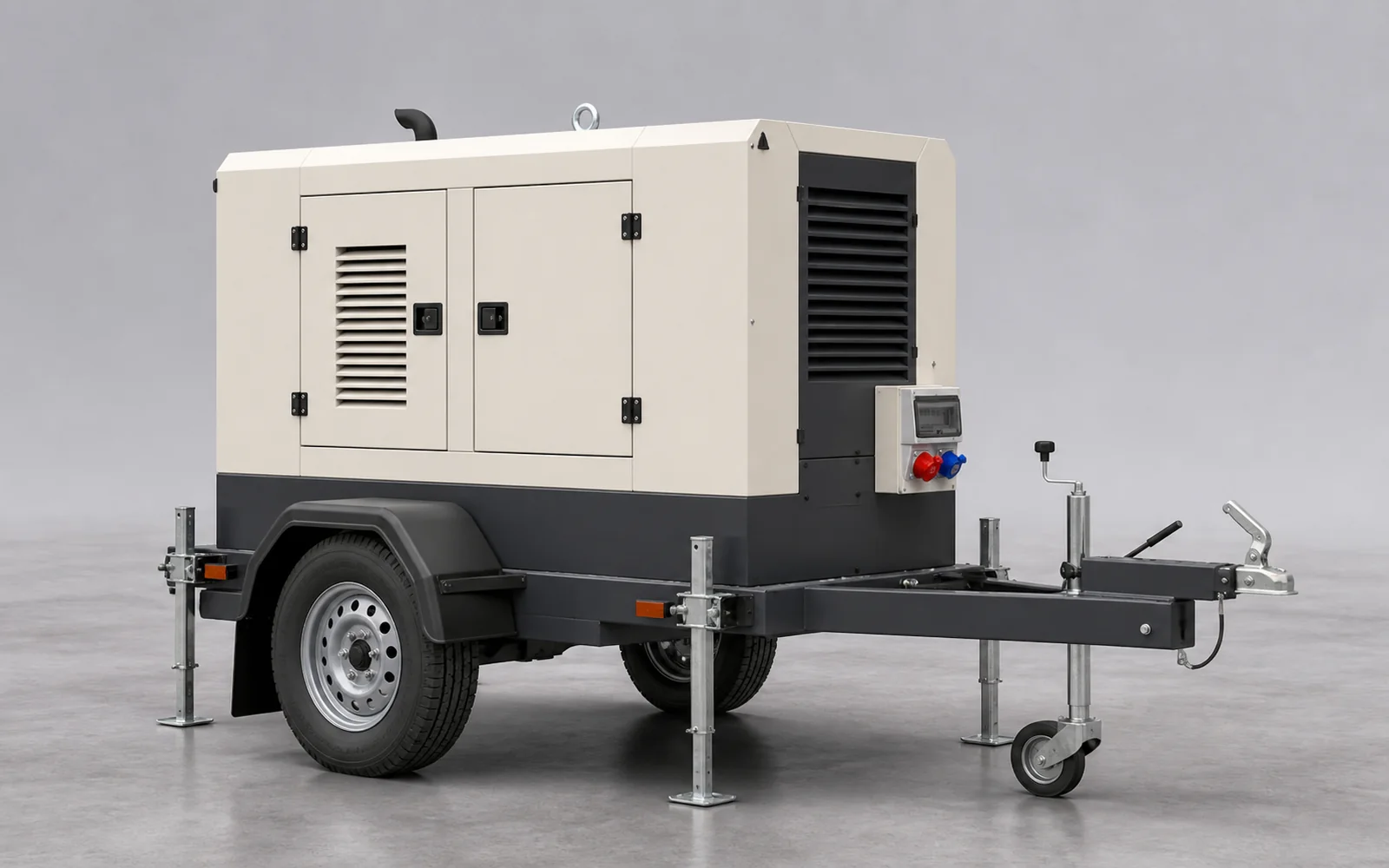
Packaging follows the site, not the catalogue photo. An open-type set belongs in a pump house or machinery shed where ventilation, exhaust and access are part of the building design - it is the simplest and often cheapest to service. A silent (acoustic-enclosure) set makes sense when the unit sits near a residence, a road, or any noise-sensitive boundary, and the enclosure also adds weather protection. A mobile-trailer set is the practical choice for moving between irrigation blocks or for seasonal work, and a containerized set suits a fixed multi-pump installation or long-term prime duty. The boundary to watch: an open set left uncovered outdoors is not protected, and a silent set crammed into a tight unventilated space can overheat - match the package to where it will actually sit, and tell the supplier the installation environment so the recommendation is real.
How do I verify emissions and noise compliance for my region?
Do not accept a verbal 'it's compliant.' Emission stage (for example EU Stage V, US EPA Tier 4, or the applicable regional standard), noise level in dB(A), and ingress-protection (IP) rating are all market-specific, and a set built for one region is not automatically legal in another. Require the supplier to provide the actual certificate or measurement report for your destination market and write the limit you need into the contract - for noise, the measured dB(A) at a stated distance and load; for IP, the rating that matches your dusty, wet or outdoor agricultural environment. A compliant document you can show your local authority is what protects you at inspection, not a line in a brochure. If a supplier cannot produce the paper for your market, treat that as a selection risk, not a detail to sort later.
How do I verify the supplier before committing?
The engine brand and the build quality are what you live with for the next decade. LINKPOWER builds open-type, silent, mobile-trailer and containerized agricultural sets with Weichai, Yuchai and SDEC engines, configured to the project rather than pulled from a shelf, and the same set can be arranged for standby, prime or off-grid duty. Before you pay, ask for three things that reveal post-sale reality: the factory acceptance test record template, the nearest service point for your destination, and the spare-parts lead time for filters, belts and consumables. A supplier that answers those in writing is one you can plan around. See the engine options and the full product range here: https://linkpowergenset.com/en/products/weichai-diesel-generator/ , https://linkpowergenset.com/en/products/yuchai-diesel-generator/ , https://linkpowergenset.com/en/products/sdec-diesel-generator/ , and the production base at https://linkpowergenset.com/en/factory/.
When should I walk away from a farm generator quote?
A low price with thin answers is the most expensive generator you can buy. Walk away, or at least pause, if the supplier: will not provide a rated fuel curve at your actual load; skips a load-bank or factory acceptance test; cannot state an IP rating suited to a dusty agricultural site; has no written maintenance or exercise schedule; is vague about emission and noise documents for your market; or cannot name a service footprint and spare-parts lead time. Also be wary of a quote built on a target kVA alone with no load list, no starting-method check, and no duty confirmation - that set may start once in the workshop and struggle every time it matters on your land. A confident supplier returns a selection table, a test scope, and a documentation package in the first response.
FAQ
Can a generator run my irrigation pump directly? It can, but motor starting is the catch. A pump motor can draw several times its running current at start, which can depress voltage and stall a small set. Give the supplier the largest motor's kilowatts and its starting method (direct-on-line, star-delta, soft starter or VFD), and require written confirmation that the set holds voltage and frequency within limits through the start.
Do I need a transfer switch for farm backup? For automatic backup of a building or dairy shed, yes - an automatic transfer switch (ATS) moves the load to the generator and back without you standing in the rain. Ask the supplier to specify the ATS rating and confirm it matches your load and earthing arrangement, and verify the transfer time if a load (like a milk cooler) is sensitive to the gap.
How often should I exercise a rarely-used farm set? Agree the schedule in the contract rather than leaving it to memory - a set that only runs when the lights fail is a set that fails when the lights fail. A short regular exercise plus a periodic loaded run, with the interval stated in the supply agreement and the O&M manual, is the minimum that keeps a seasonal set trustworthy.
What we need from you
Send the load list with starting methods, the duty (standby, prime or off-grid continuous), the site conditions, the runtime between refuels, and your local emission and noise limits. We will configure the package, run the factory acceptance test against your step load, and return the report with a project quotation - service footprint and spare-parts lead time stated up front. For agricultural and remote-site projects, start here: https://linkpowergenset.com/en/applications/agriculture/.