A standby generator for a commercial building is not a box you bolt down and forget. It is a load-specific, code-bound purchase that decides whether your lifts, servers, refrigeration and fire pumps keep running when the grid drops. On 2026-10-22, Power Engineering International reported that America's data-center construction is being delayed by grid constraints, and that same grid pressure is now reaching commercial buildings that never budgeted for on-site power. This guide covers what size you actually need, which rating fits backup duty, how to verify a supplier's claims before you pay, and the red flags that mean you should walk.
What size standby generator does a commercial building actually need?
Size it on the connected critical load and the starting surge of your largest motors - never on floor area. A 10,000 m2 open-plan office and a 10,000 m2 cold-store warehouse pull completely different kVA, because the load is what runs, not the square metres. Build a load list: every circuit you must keep alive during an outage, its running kW, its power factor, and how each motor starts. Direct-on-line starting pulls several times the running current for a few seconds; a soft starter or VFD cuts that hard spike. Add the starting surges with the right diversity factor, then size the alternator so the largest step load does not dip voltage past what your equipment tolerates. As a planning figure only, small offices and retail often land in the 20-100 kVA band, while mid-size buildings with lifts, chillers or multiple HVAC plants sit in 100-500 kVA - but treat those as a sanity check, not the answer. The real number comes from your distribution board, not a rule of thumb. See the small-set range for offices and retail and the mid-range options for larger buildings.
Does a silent enclosure mean my building meets noise limits?
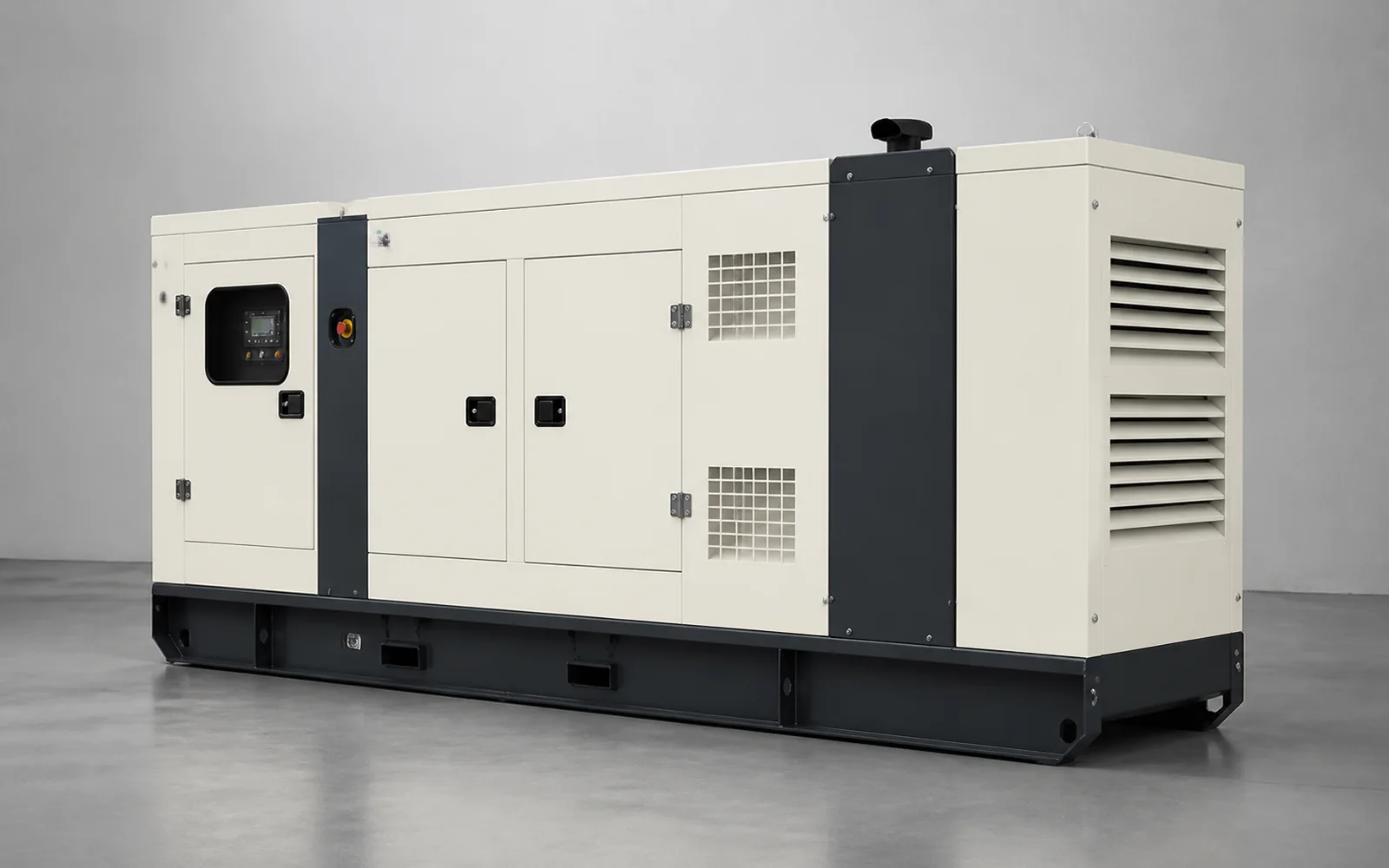
No, and this is where buyers get fined. A 'silent' or 'super-silent' label is a marketing category, not a permit. The only number that matters is a measured sound level at a defined distance and height, taken by a stated method - ask for the test to ISO 3744 or an equivalent national standard - and even that figure shifts on site because distance to the nearest residence, reflective walls and ground cover all change the result. Before you buy, ask the supplier for the actual test report with the measurement distance and method, then have a local acoustic assessment done against your municipal ordinance, and put the acceptable limit and the measurement condition into the contract. If a supplier hands you a brochure dB(A) and calls it 'compliant,' they are describing a factory condition you may never achieve on your rooftop. For noise-sensitive rooftops, review the silent enclosure range built for exactly this boundary.
Which rating - standby, prime, or continuous - fits a commercial building?
For backup duty, you almost always want the standby rating, and mixing the ratings up is the most expensive mistake here. Standby is built for occasional outages: it carries a variable load up to its nameplate for a limited number of run-hours per year, which is exactly what a building needs when the grid fails a few times annually. Prime is for variable load with unlimited hours but a capped average load - that is a construction site or an islanded microgrid, not your backup closet. Continuous is constant base-load, 24/7. Run a standby-rated set as if it were prime and you erode the duty basis the warranty was written on. Confirm the rating basis to ISO 8528-1 with your supplier, write the annual run-hour ceiling into the contract, and size the set to the rating you will actually use - not the bigger number on the brochure. In the US, emergency and legally required standby systems are referenced under NEC Articles 700 and 701 - confirm the exact edition and local amendments with your authority having jurisdiction.
How do I verify a commercial standby generator before buying?
Verify from documents and a factory test, not from the sales chat. A practical checklist: (1) Send the supplier your load list with each load's starting method, power factor and required voltage - a quotation without it is a guess. (2) Confirm the rating basis (standby vs prime) and the annual run-hour cap, stated in writing. (3) Match the alternator and automatic transfer switch (ATS) - voltage, phase, neutral and earthing must agree, or the transfer fails on the first outage. (4) Require a factory acceptance test report showing step-load and rated-load runs, voltage and frequency regulation, and any motor-starting you specified. (5) For emissions, CE marking and ISO certifications, ask for the actual documents applicable to your destination market - what CE covers, what it does not, and which directive applies - rather than accepting a generic 'CE certified' line. (6) Check the nameplate, warranty terms and the commissioning plan for your country. Put every figure above into the purchase contract so the quotation is checked against your real system. LINKPOWER runs the factory acceptance test against your specified step load and motor starting before crating, and the engine options span Weichai, Yuchai and SDEC across open, silent, mobile and containerized packages.
When should I walk away from a commercial generator supplier?
Walk away, or at least pause hard, if the supplier: quotes a kVA without ever asking for your load list or distribution board; cannot state the rating basis or the annual run-hour ceiling; calls a silent enclosure 'noise-compliant' with no test report at a defined distance; shows no factory test evidence and shrugs when you ask; claims 'CE certified' or a specific emissions stage as fact without providing the actual certificate and scope; or refuses to put the figures, limits and warranty into the contract. A supplier that exports and commissions regularly answers these in one message with a drawing and a test report. One that cannot is asking you to discover the failure during your first blackout - in front of your tenants and the fire inspector.
How LINKPOWER builds standby sets for commercial buildings
LINKPOWER is a factory-direct builder of diesel generator sets with Weichai, Yuchai and SDEC engines, offered in open, silent, mobile-trailer and containerized formats so the package fits the site - a silent enclosure for a noise-sensitive rooftop, a containerized unit for a large complex with space to spare. The alternator, controls and ATS interface are configured to your confirmed electrical standard rather than a catalog default, and the factory acceptance test proves the set against your step load and motor starting before it ships. Because the units are built to order, the sizing starts from your load list and duty, not from a stock number. See the silent range for noise-sensitive rooftops (https://linkpowergenset.com/en/products/silent-diesel-generator/), the small-set range for offices and retail (https://linkpowergenset.com/en/products/20-100-kva-diesel-generators/), the mid-range options for larger buildings (https://linkpowergenset.com/en/products/100-500-kva-diesel-generators/), the commercial-buildings application notes (https://linkpowergenset.com/en/applications/commercial-buildings/), and the factory test process (https://linkpowergenset.com/en/factory/).
FAQ
Do I need a generator for a building with two grid feeds? Often not for short interruptions - a second feed covers a single-source fault. But if both feeds share a substation or a regional outage takes both, a standby set still closes the gap. Size and decide based on your actual outage history, not the theory.
Can one standby set cover an entire building? Yes, if it is sized to the total critical load and the ATS transfers the right bus. Many buildings run a single set for life-safety and selected circuits, and leave non-critical loads on the grid. Confirm which circuits are critical before sizing - that decision sets the kVA more than the building's size does.
Is diesel still the right fuel for commercial backup? For most buildings, yes - diesel standby is proven, fast-starting and fuel-dense, and the set sits idle most of its life. Whether your market restricts diesel emissions or requires a staged fuel reserve is a local rule, so confirm the applicable emissions stage and any on-site fuel limits with your supplier and authority having jurisdiction rather than assuming.
What we need from you
Send the critical load list with each load's starting method and power factor, the supply voltage and earthing standard, the duty (standby, prime or continuous), frequency, and whether an ATS is involved. We confirm the rating basis and alternator configuration, run the acceptance test against your step load and motor starting, and return a quotation built to your building - not a catalog default. Start the configuration from the full product range (https://linkpowergenset.com/en/products/) and the factory test process (https://linkpowergenset.com/en/factory/).